

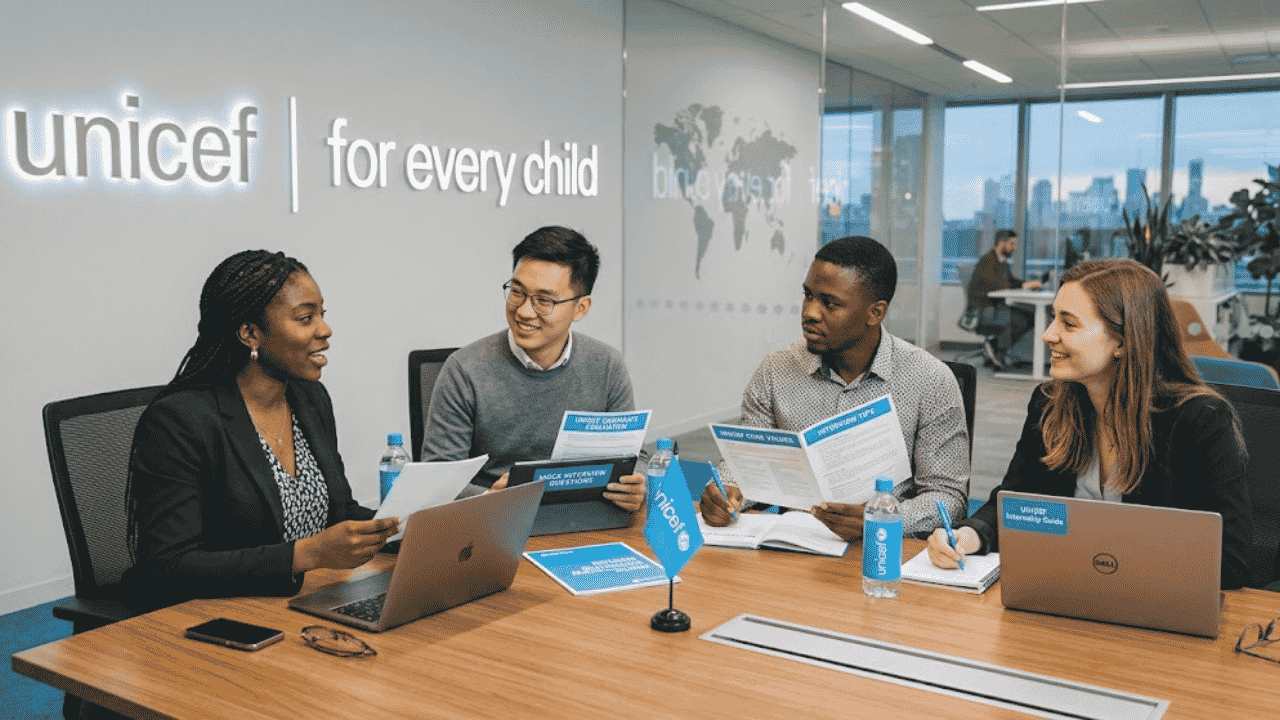
Preparing for a UNICEF internship interview can be challenging, especially if you have never interviewed for an international organisation before. However, with proper preparation, you can improve your confidence and present your skills more effectively.
The UNICEF Internship Programme gives eligible students and recent graduates an opportunity to gain practical experience in areas such as education, child protection, public health, communications, research and programme support.
If you are planning to apply for a UNICEF internship in 2026–2027, this guide covers common interview questions, sample answers, competency-based questions and useful preparation tips.
Note: These are practice questions to help you prepare. UNICEF does not use one fixed interview questionnaire for every internship. Questions depend on the position, department and recruitment process.
Read More: How to Apply for UNICEF Internship: Step-by-Step Application Guide
What Is the UNICEF Internship Interview Process?
The selection process varies depending on the internship position. It may include an application review, an interview, a written assignment, a technical assessment or other selection steps.
During an interview, recruiters may assess your motivation, academic background, communication skills, problem-solving abilities and suitability for the role.
Applicants should carefully read the vacancy description and follow any instructions provided in the interview invitation.
Top 15 UNICEF Internship Interview Questions and Sample Answers
Here are 15 common practice questions that can help you prepare for a UNICEF internship interview.
1. Tell Us About Yourself
Sample answer:
“I am currently studying [your degree] at [your university]. During my studies, I have developed skills in research, communication and teamwork through academic projects and other activities. I am interested in gaining practical experience in international development and using my skills to contribute to meaningful projects. I believe this internship would help me learn from experienced professionals and develop my career.”
Preparation tip: Keep your introduction short and focus on your education, relevant skills and career goals.
2. Why Do You Want to Work With UNICEF?
Sample answer:
“I am interested in UNICEF because of its work supporting children’s rights and improving access to education, healthcare and protection. I would like to learn how international development programmes operate and contribute my skills to the team. This internship would also give me an opportunity to grow professionally while supporting work that benefits children and communities.”
Preparation tip: Research UNICEF’s mission and identify a specific area of its work that genuinely interests you.
3. What Do You Know About UNICEF?
Sample answer:
“UNICEF is the United Nations Children’s Fund. It works to protect children’s rights and improve their health, education, safety and development. The organisation works with governments, communities and other partners to support children, particularly those facing difficult circumstances.”
Preparation tip: Visit the official UNICEF website and learn about its work in the country or programme related to your application.
4. Why Should We Select You for This Internship?
Sample answer:
“I believe I could contribute through my academic knowledge, willingness to learn and ability to work responsibly. I am organised, open to feedback and interested in developing the skills required for this position. I would take my responsibilities seriously and work collaboratively with the team.”
Preparation tip: Mention two or three strengths that match the internship requirements.
5. What Are Your Greatest Strengths?
Sample answer:
“My main strengths are organisation, communication and problem-solving. Through my studies and projects, I have learned how to manage deadlines, research information and work with others to complete tasks. I am also willing to ask questions when I need clarification and use feedback to improve my work.”
Preparation tip: Support your strengths with a genuine example from your education, volunteering or previous projects.
6. What Is Your Biggest Weakness?
Sample answer:
“Sometimes I spend too much time checking my work because I want to make sure it is accurate. I am improving by setting clear deadlines, prioritising important tasks and reviewing my work within a reasonable amount of time.”
Preparation tip: Choose a genuine weakness and explain what you are doing to improve it.
7. How Do You Handle Working Under Pressure?
Sample answer:
“When I have several deadlines, I list my tasks and identify the most urgent ones. I divide larger assignments into smaller steps and monitor my progress. If priorities change or I expect a delay, I communicate with the people involved. This approach helps me stay organised and maintain the quality of my work.”
Preparation tip: Prepare a real example of how you managed competing deadlines.
8. Describe a Time You Worked in a Team
Sample answer:
“During a university project, I worked with other students to complete an assignment within a limited time. We divided responsibilities according to our strengths and agreed on deadlines. I completed my part, shared updates and helped review the final work. This experience taught me the importance of communication and accountability.”
Preparation tip: Use a real example from university, volunteering, a student society or a personal project.
9. How Would You Handle a Disagreement With a Colleague?
Sample answer:
“I would listen carefully to the other person’s perspective and explain my own view respectfully. I would focus on the project’s objectives rather than making the disagreement personal. If we could not reach an agreement, I would ask the appropriate supervisor for guidance.”
Preparation tip: Demonstrate respectful communication, teamwork and a willingness to resolve problems professionally.
10. What Do You Understand About Children’s Rights?
Sample answer:
“Children have rights that protect their safety, education, health, development and participation in matters affecting them. These rights are reflected in the United Nations Convention on the Rights of the Child. I understand that protecting children requires respect for their dignity, safety and individual circumstances.”
Preparation tip: Read about the Convention on the Rights of the Child and understand how it relates to UNICEF’s work.
11. How Would You Handle Confidential Information?
Sample answer:
“I would follow the organisation’s policies and my supervisor’s instructions. I would only access information necessary for my responsibilities and would not share confidential details with unauthorised people. If I were unsure how to handle particular information, I would ask for guidance.”
Preparation tip: Show that you understand the importance of privacy, confidentiality and professional responsibility.
12. What Would You Do if You Noticed a Mistake in Your Work?
Sample answer:
“I would check the information, correct the mistake as soon as possible and inform the relevant colleague or supervisor if the error had already been shared or could affect a decision. I would also review how the mistake happened so I could reduce the chance of repeating it.”
Preparation tip: Demonstrate honesty, accountability and a willingness to learn from mistakes.
13. How Would You Respond to a Sensitive Situation Involving a Child?
Sample answer:
“I would remain calm, listen respectfully and prioritise the child’s safety and dignity. I would follow the organisation’s safeguarding procedures and report the concern through the appropriate channels. I would not attempt to investigate the situation myself or promise absolute secrecy.”
Preparation tip: Understand that safeguarding concerns must be handled according to the relevant policies and reporting procedures.
14. What Skills Can You Bring to This Position?
Sample answer:
“My relevant skills include research, communication, organisation and the ability to learn new tools quickly. I have developed these skills through my studies and practical projects. I would use my existing abilities while learning the specific systems and procedures required by the team.”
Preparation tip: Match your skills to the responsibilities listed in the internship vacancy.
15. Do You Have Any Questions for Us?
At the end of the interview, the recruiter may ask whether you have any questions.
You can consider asking:
- What would the main responsibilities of the intern be during the first few weeks?
- Which projects would the selected intern support?
- What skills are most important for success in this role?
- How would the team provide guidance and feedback?
- What would a successful internship look like by the end of the placement?
Choose questions that have not already been answered during the interview.
Also See: How to Write a UNICEF Internship Cover Letter (With Example)
Competency-Based UNICEF Internship Interview Questions
Some interviews focus on how you handled situations in the past. These are known as competency-based or behavioural questions.
Practise answering questions such as:
- Tell us about a time you solved a difficult problem.
- Describe a situation in which you had to meet a tight deadline.
- Give an example of when you received feedback and acted on it.
- Tell us about a time you had to learn something quickly.
- Describe a situation in which you worked with people from different backgrounds.
- Tell us about a mistake you made and what you learned from it.
- Give an example of when you took responsibility for completing a task.
You can use genuine examples from your studies, volunteering, research, student societies or personal projects. Previous professional employment is not the only way to demonstrate relevant skills.
How to Answer Interview Questions Using the STAR Method
The STAR method helps you organise your answers and explain your experience clearly.
S — Situation: Explain the background and what was happening.
T — Task: Describe your responsibility or the problem you needed to solve.
A — Action: Explain the specific steps you took.
R — Result: Describe the outcome and what you learned.
Example of the STAR Method
Question: Tell us about a time you managed a difficult deadline.
Situation: During my final semester, I had two assignments due in the same week.
Task: I needed to complete both assignments while maintaining the quality of my work.
Action: I created a schedule, divided the assignments into smaller tasks and completed the most urgent sections first. I also reviewed my progress each day.
Result: I submitted both assignments on time and learned how planning ahead can help me manage competing priorities.
Use your own experience when preparing for an interview. This example simply demonstrates how to structure an answer.
UNICEF Internship Interview Preparation Checklist
Before your interview, make sure you have completed these preparation steps.
- Read the complete internship vacancy and understand the main responsibilities.
- Research UNICEF’s mission and the work of the relevant office.
- Prepare a short introduction about your education and skills.
- Practise common motivation and competency-based questions.
- Prepare three or four real examples using the STAR method.
- Review your CV and submitted application.
- Check the interview time, time zone and meeting platform.
- Prepare two or three relevant questions for the interviewer.
Completing this checklist can help you feel more organised and confident before the interview.
Tips for Online UNICEF Internship Interviews
Some UNICEF internship interviews may take place online. If you receive a virtual interview invitation, follow these tips:
- Test your internet connection, microphone and camera in advance.
- Choose a quiet place with suitable lighting.
- Keep your CV and the vacancy description available for reference.
- Join the meeting a few minutes early.
- Speak clearly and keep your answers focused.
- Listen carefully to each question before responding.
- Follow the interviewer’s instructions if a written or technical assessment is included.
If the interviewer is in another time zone, double-check the scheduled time to avoid missing the meeting.
Common Mistakes to Avoid During a UNICEF Interview
Avoid these mistakes when preparing for your interview:
- Memorising answers without understanding the questions.
- Giving vague answers without relevant examples.
- Failing to research the internship position.
- Exaggerating your skills or qualifications.
- Speaking negatively about previous teachers, colleagues or teammates.
- Ignoring questions about confidentiality and safeguarding.
- Giving excessively long answers that do not address the question.
- Failing to ask for clarification when you do not understand a question.
If you do not know an answer, remain honest. Explain how you would find the correct information or seek guidance from an appropriate colleague.
Official UNICEF Internship Resources
Use the following official resources to learn about the programme and find current opportunities.
UNICEF Internship Programme:
https://www.unicef.org/careers/internships
UNICEF Careers and Vacancies:
https://jobs.unicef.org/
Internship Frequently Asked Questions:
https://www.unicef.org/careers/frequently-asked-questions-internships
UNICEF Official Website:
https://www.unicef.org/
The official vacancy announcement is the best source for position-specific recruitment instructions and requirements.
Frequently Asked Questions
What questions are asked in a UNICEF internship interview?
Questions may cover your background, motivation, relevant skills, teamwork, communication, problem-solving and understanding of UNICEF’s work. Actual questions vary by position.
Is the UNICEF internship interview difficult?
The difficulty depends on the position and recruitment process. Researching the role, practising common questions and preparing real examples can help you answer more confidently.
How should I introduce myself in a UNICEF interview?
Briefly explain your current education, relevant skills, experience and interest in the internship. Keep your introduction focused on the position you are applying for.
Does UNICEF ask technical questions during internship interviews?
Some positions may include technical questions, written assignments or practical assessments. For example, a data-related role may assess analytical skills, while a communications position may require writing or content-related tasks.
Can I pass a UNICEF internship interview without work experience?
Relevant professional experience is not a universal requirement for every internship. You can demonstrate your abilities through academic assignments, volunteering, research and personal projects.
How long does a UNICEF internship interview last?
The duration varies by position and recruitment process. Follow the instructions in your interview invitation and ask the recruitment contact if you need clarification.
When are UNICEF internship interview results announced?
There is no single result announcement date for all internships. Recruitment timelines vary by vacancy, and applicants should monitor their email and application account for updates.

1 thought on “UNICEF Internship Interview Questions and Preparation Tips”